
DTF vs. Screen Printing: Which One Is Right for Your Business?
Compare DTF and screen printing on setup costs, order minimums, cost per shirt at scale, and durability to pick the right method for your print shop.
The Decision Every Print Shop Owner Faces
If you're running a custom apparel business — or thinking about starting one — you've almost certainly hit the DTF vs. screen printing question. Both methods produce great-looking shirts. Both have loyal followers in the industry. But they're built for very different kinds of work, and picking the wrong one for your order volume or customer base can quietly eat into your margins.
This guide breaks down the real differences: what you pay to get started, how the numbers change as order size scales, what quality actually looks like after 30 washes, and which method fits the way your business actually runs. No manufacturer hype — just the numbers and tradeoffs that matter for a working print shop.
1. What You Pay Before Printing a Single Shirt
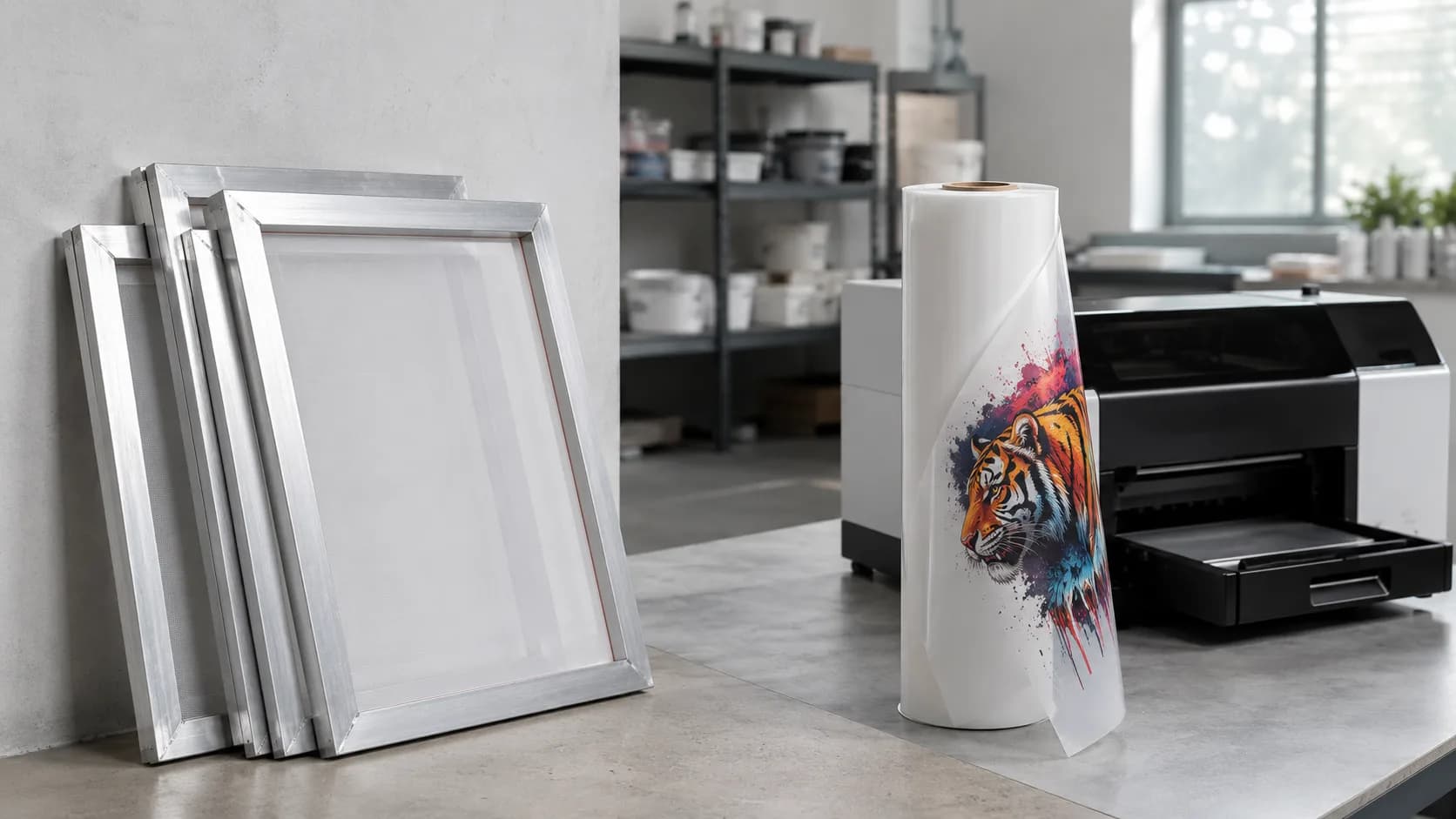
The first cost most people overlook is setup — everything that happens before the first shirt comes off the press.
With screen printing, setup is where the money goes fast:
- Each color requires its own screen, typically priced at $25–$45 per screen. A 3-color design runs $75–$135 in screen charges before printing starts.
- Total pre-production costs for a single design (including burning, reclaiming, and registration) routinely reach $150–$250 per setup, according to Anatol's screen printing pricing guide.
- If a design changes, you burn new screens and pay again. Last-minute artwork corrections aren't just stressful — they're expensive.
- Entry-level screen printing setups (press, exposure unit, washout booth, dryer) run $1,000–$5,000+, and that's before ink, emulsion, and mesh.
With DTF, setup is almost nothing:
- No screens, no films, no per-color charges. You design, you print, you press. A 10-color gradient costs the same setup time as a 1-color logo.
- Entry-level DTF equipment (printer, powder shaker, curing oven) starts around $1,500–$3,000 for in-house setups — or you skip the equipment entirely by ordering gang sheets from DTF Engine and paying only per transfer.
- Design changes cost you nothing extra. Swap the file, reprint. No wasted screens.
- No minimum artwork complexity. Photorealistic prints, fine text, and gradients all process the same way.
If your customers regularly request last-minute changes or multi-color artwork, DTF's zero-setup-cost structure is a meaningful operational advantage.
2. Order Minimums and Who They Hurt
This is the single biggest practical difference between the two methods — and it's the one that most directly affects whether you can say yes to a customer.
Screen printing minimums exist because setup costs don't change regardless of quantity:
- Most screen printers require a minimum of 24–48 pieces per design to make setup costs worth absorbing. Some shops go as low as 12, but usually with a surcharge.
- Designs with 5+ colors often carry a 100-piece minimum, because the screen count makes small runs economically impossible.
- Repeat orders are easy — screens can be stored and reused for the same design, making reorders cheaper and faster.
- Charity events, family reunions, team orders — anything under 24 pieces is where screen printing shops either say no or quote prices that lose the customer.
DTF has no meaningful minimums:
- One shirt is a valid order. There are no setup fees to recover, so single-piece orders are as profitable per unit as large runs.
- Mixed designs ship together. A gang sheet can carry 10 different designs in one print run, which is impossible with screen printing.
- Small, frequent orders — the bread and butter of Etsy sellers, pop-up shops, and event vendors — are DTF's sweet spot.
- No storage of screens or film. Every order starts fresh from a digital file, which means no physical inventory of printing assets to manage.
3. Cost Per Shirt: Where the Math Flips
This is where screen printing advocates have a legitimate point — and where DTF shops need to be honest with their customers.
The cost-per-unit comparison depends entirely on quantity:
- Under 50 pieces, DTF wins clearly. Per-transfer costs of $1.00–$1.50 per placement, with no setup fee, consistently beat screen printing's per-unit cost once you factor in the screen charges spread across a small run.
- At 100–150 pieces, they're roughly equal, depending on color count and supplier. This is the crossover zone where the math can go either way.
- At 500+ pieces, screen printing's economies of scale take over. Per-unit costs drop to $0.50–$0.80 at volume, according to SAM Ink's 2025 cost comparison, compared to DTF's $1.00–$1.20 range that holds fairly flat regardless of quantity.
- At 1,000+ pieces, screen printing is cheaper per unit by a meaningful margin — assuming the design doesn't change between runs and color count stays low.
- Specialty garments change the equation. Screen printing on dark shirts requires an underbase, adding a color (and a screen). A "3-color design" on black is actually 4 screens. DTF prints on dark garments without an underbase, which can flip the cost comparison even at mid-volume runs.
4. Print Quality and Durability After Real-World Use
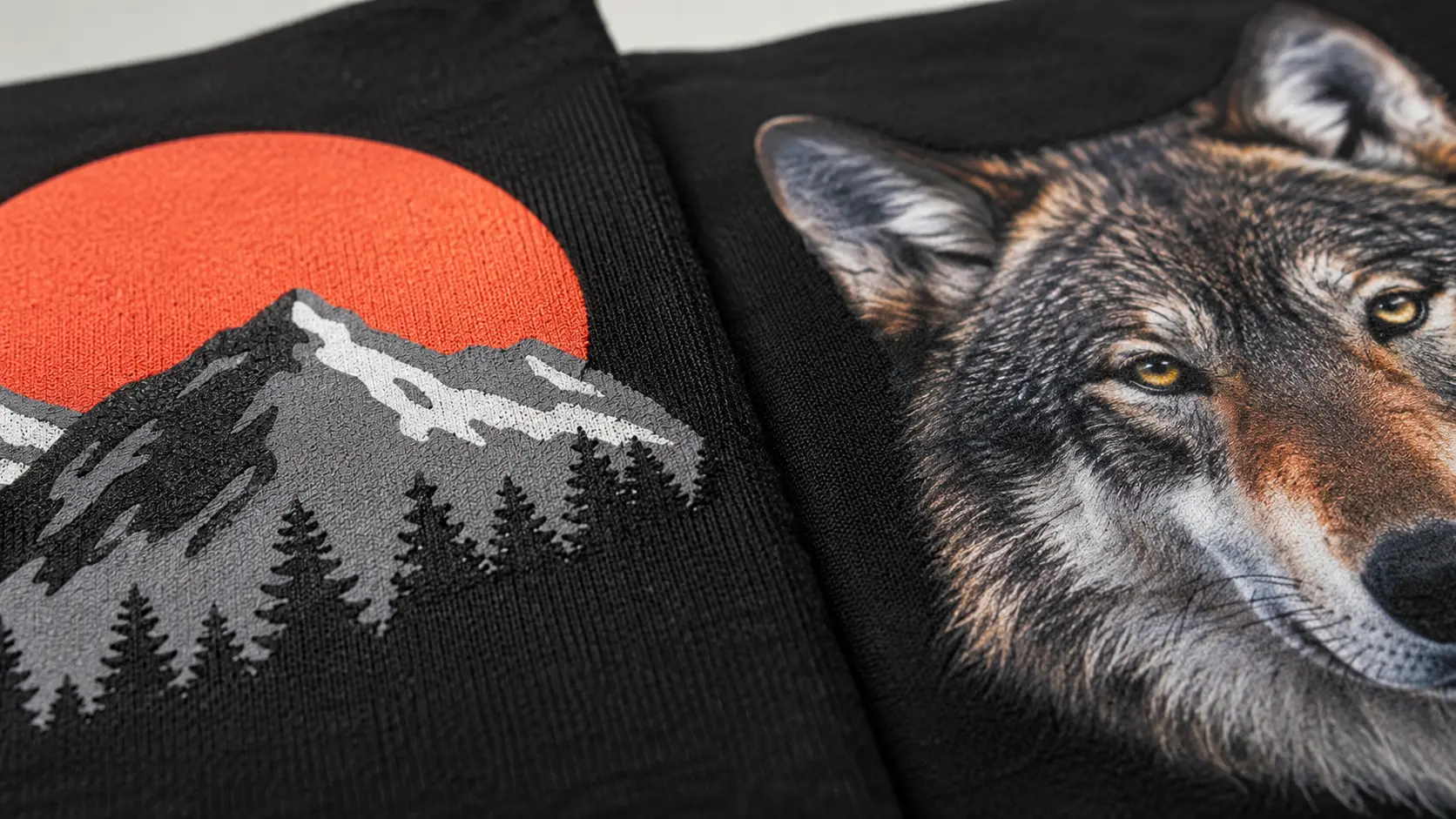
Both methods can produce great results. Where they differ is in what "great" looks like and how long it lasts.
What screen printing does best:
- Vibrant, opaque spot colors — ink sits on top of the fabric with a richness that's hard to match, especially on dark garments.
- Wash durability on simple designs — a well-cured plastisol print can last 50+ washes without significant fading, which is why athletic uniforms have used screen printing for decades.
- Soft hand feel — specialty inks like water-based and discharge give a "printed into the fabric" feel that DTF can't replicate.
- Limited complexity — fine details, gradients, and photographic images are difficult to reproduce accurately in spot-color screen printing.
What DTF does best:
- Full-color photorealistic prints — gradients, shadows, skin tones, and complex artwork all translate accurately without color separation.
- Small text and fine lines — DTF holds detail down to a few points of type, where screen printing starts to lose edge sharpness.
- Consistent wash performance — properly cured DTF transfers hold up for 50+ washes on most fabrics, comparable to screen printing for most everyday apparel applications.
- Works on more substrates — cotton, polyester, nylon, blends, and even some hard goods accept DTF transfers where screen printing is limited to flat, fabric surfaces.
5. Turnaround Time and Day-to-Day Workflow
How fast can you get an order out the door? The answer affects your pricing, your customer promises, and your stress level.
Screen printing timeline realities:
- Artwork approval and film output add 1–2 days before production even starts.
- Screen burning and setup takes 30–60 minutes per job, not counting drying time for coated screens.
- Production is fast at volume — an experienced press operator can run 500+ shirts per hour once the press is set.
- Cleanup and reclaiming add 30–45 minutes after each job, time that doesn't exist in DTF workflows.
DTF timeline advantages:
- No pre-production delays — approved artwork goes straight to print. Most DTF Engine orders are ready for carrier pickup within 2–3 business days, as outlined on the shipping page.
- Print speed is slower per unit than a running screen press, but there's no setup or teardown time offsetting it on small jobs.
- Mistakes don't cost you a screen. A reprinted DTF transfer costs pennies in ink and film. A ruined screen setup can cost $50–$100+ to redo.
- Rush jobs are easier to absorb. No equipment reconfiguration, no screen prioritization — just queue the file and print.
Key Takeaways
- DTF is the better choice for orders under 100 pieces, mixed designs, or any job where the artwork is complex or photorealistic.
- Screen printing wins on cost-per-unit at 500+ pieces for simple, solid-color designs that won't change between runs.
- Screen printing charges $25–$45 per screen per color, plus $150–$250 in total setup — costs DTF never incurs.
- Both methods can achieve 50+ wash durability when properly cured; screen printing has a slight edge on abrasion resistance for heavy-use garments.
- DTF accepts no-minimum orders; most screen printers require 24–48 pieces, with high-color-count designs often requiring 100+.
- For shops serving Etsy sellers, pop-up vendors, event organizers, or anyone who needs flexibility and speed, DTF is the operationally simpler choice.
Frequently asked questions
Is DTF printing cheaper than screen printing?
It depends on quantity. DTF is typically cheaper for orders under 100 pieces because there are no per-color setup fees. Screen printing becomes more cost-effective at 500+ pieces, where its economies of scale bring per-unit costs to $0.50–$0.80 compared to DTF's $1.00–$1.20.
Does DTF printing last as long as screen printing?
For most everyday apparel, yes — properly cured DTF transfers hold up for 50 or more wash cycles. Screen printing has a slight edge in abrasion resistance for heavy-use items like workwear or athletic uniforms, but the difference is minimal for standard garment applications.
What's the minimum order for DTF printing?
DTF has no minimum order requirement. You can print one shirt or one thousand. Screen printing typically requires 24–48 pieces per design at minimum, and designs with five or more colors often require 100 pieces.
Can screen printing reproduce photographic images?
Not well. Screen printing uses spot colors, which means photographic images need to be color-separated into halftone dots — a process that loses detail and accuracy. DTF prints full-color artwork directly, making it the better choice for photos, gradients, and complex illustrations.
Which method is better for a new print business?
DTF is generally easier to start with: lower equipment costs, no minimums, no screen inventory, and faster turnaround on small jobs. Screen printing becomes worth the investment once you are consistently running orders of 300+ pieces for the same design.
Ready to print?
Upload your first gang sheet
No setup fees. No minimums. Professional DTF film shipped in 2–3 business days.